
Sorry. We did not find anything.
Choosing the right Karting Kart manufacturer requires more than comparing prices or browsing polished factory photos. Global buyers need evidence of engineering quality, production consistency, safety practice, and dependable after-sales support. These details matter when a fleet faces repeated braking, vibration, heat, and demanding rental schedules.
Industry reports show why this market deserves careful evaluation. Grand View Research estimates that the global go-kart market will continue expanding through the decade, supported by leisure parks, racing facilities, and experience-based entertainment. Fortune Business Insights also identifies indoor entertainment centers and organized motorsport as important growth drivers. However, these reports use different market definitions. Their figures should guide research, not replace supplier verification.
A useful expert perspective comes from Dino Chiesa, a respected karting engineer and former CRG team manager. He has described karting as “the purest form of motorsport.” That purity exposes weak design quickly. Poor steering alignment, inconsistent welds, or fragile bodywork become visible after only a few operating days.
For international purchasers, the strongest manufacturers combine tested chassis geometry, reliable engines or electric systems, accessible spare parts, and documented quality control. They should explain battery safety, maintenance intervals, warranty coverage, and compliance with destination-market requirements. Factory audits and sample testing remain essential. A brochure cannot prove durability.
This guide examines leading China-based Karting Kart manufacturers for global buyers. It focuses on measurable capabilities, export experience, customization, technical communication, and long-term operating value. Some rankings may remain subjective. That limitation deserves honesty. Supplier performance can change, and independent verification is still necessary before signing a large order.
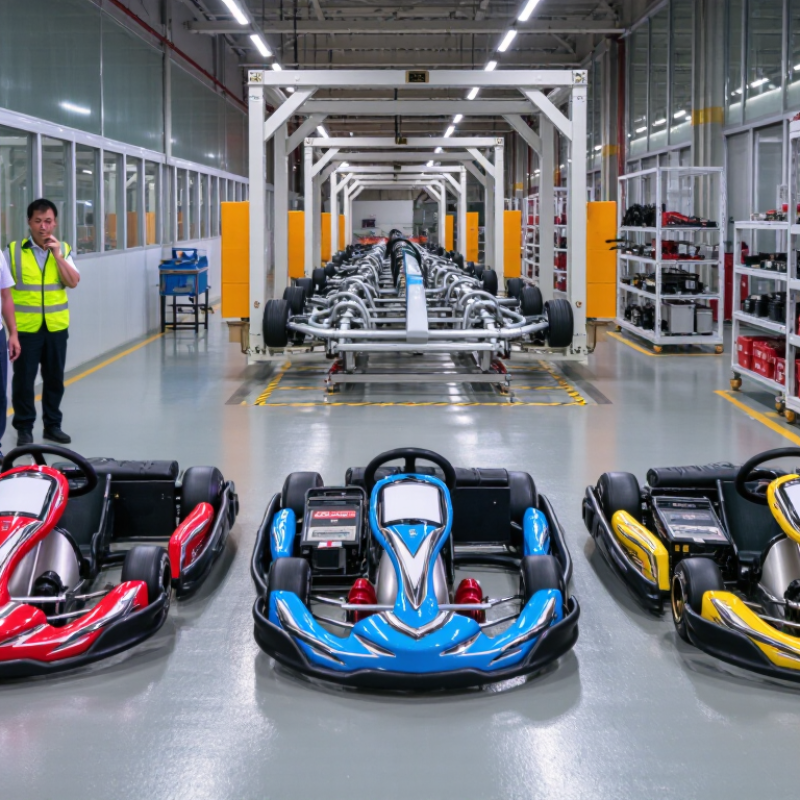
China’s karting manufacturing sector covers OEM production, custom assembly, components, and export support. Product categories include electric rental karts, gasoline racing karts, youth models, off-road karts, and track-control systems. Electric models increasingly use lithium battery packs, regenerative braking, and programmable speed limits. Racing versions usually require stronger frames, adjustable pedals, hydraulic brakes, and replaceable body panels.
Market estimates differ. Fortune Business Insights reported continued growth in the global go-kart market through 2030, while Grand View Research identified electric propulsion as a major growth direction. These reports combine recreational, commercial, and racing applications, so buyers should read their definitions carefully. China’s strength is manufacturing depth. A single supplier may coordinate welding, powder coating, wiring, battery integration, and spare parts. The categories overlap. That matters.
Tips: Ask for frame material, motor rating, battery chemistry, charging time, brake-test records, and spare-part availability. Request sample inspection before volume production. Check whether published range data reflects track conditions or laboratory testing. I would not trust unusually high speed claims without load, slope, and endurance results. Safety documentation should match the destination market and operating environment. Small details matter. A loose connector can stop an entire rental fleet.
Evaluating Chinese kart suppliers requires more than comparing unit prices. Check factory experience, engineering staff, and documented production controls. The ISO Survey 2022 recorded 1,265,216 ISO 9001 certificates across 182 countries and economies. Certification helps, but it does not guarantee consistent kart quality. Request the certificate scope, audit date, corrective-action records, and sample batch reports. Then compare those documents with a physical factory visit.
Ask for evidence. A reliable supplier should provide drawings, material certificates, welding procedures, brake tests, steering inspections, and final-load records. For electric karts, verify battery traceability, protection settings, charger compatibility, and UN 38.3 transport-test documentation. IEC 62619 may also guide industrial battery safety evaluation. For leisure karts, EN 16230-1 offers useful safety criteria, although market requirements can differ. Treat CE markings carefully; they require technical evidence, not only a printed logo. The EU Safety Gate 2023 report logged 3,412 product-safety alerts, showing why traceability deserves serious attention. Ask for serial-number records and recall procedures. Numbers help.
A supplier may pass an audit and still miss defects in one shipment. I have seen polished samples hide weak fasteners or uneven weld finishing. Independent pre-shipment inspection remains valuable. Check ten or more randomly selected units, record torque readings, and test emergency-stop performance. Leave room for doubt. A low-cost quote can become expensive after spare-parts delays, unclear warranty terms, or inconsistent packaging. Supplier evaluation should measure repeatability, not presentation quality.
A practical supplier-evaluation matrix for comparing kart manufacturers without relying on company or brand names. Scores can be assigned from 1 to 5 after document review, sample inspection, and factory verification.
| Evaluation Category | Key Standard or Benchmark | Buyer Verification Points | Suggested Weight | Priority | Scoring Guidance |
|---|---|---|---|---|---|
| Quality Management | Valid ISO 9001 certification with a scope covering kart design, manufacturing, or vehicle assembly. | Check certificate validity, certification body, factory address, covered processes, internal inspection procedures, and corrective-action records. | 12% | Essential | 5 = Valid and independently verifiable; 3 = Documented internal system only; 1 = No consistent quality system. |
| Product Safety Design | Documented risk assessment covering steering, braking, drivetrain, rotating parts, rollover risks, hot surfaces, and user access points. | Review technical drawings, safety guards, emergency-stop design, braking redundancy where applicable, seat-belt anchorage, and operating instructions. | 15% | Essential | 5 = Formal risk assessment and tested safeguards; 3 = Basic safety features without complete records; 1 = Unresolved hazards. |
| Market Compliance | Conformity documentation matched to the destination market and product configuration. | Request declarations, technical files, user manuals, warning labels, testing reports, and evidence that documentation matches the supplied model. | 12% | Essential | 5 = Complete destination-market file; 3 = Partial documentation requiring buyer work; 1 = Unsupported compliance claims. |
| Electrical System | For electric karts, electrical design should be documented against applicable machinery and electrical-safety requirements, including appropriate protection against shock, overcurrent, and unintended start-up. | Check wiring diagrams, insulation protection, fuse or circuit-breaker selection, charger specifications, IP ratings where relevant, emergency isolation, and component traceability. | 10% | If Electric | 5 = Complete drawings and test records; 3 = Functional system with limited documentation; 1 = Unsafe or undocumented modifications. |
| Battery and Shipping Safety | Lithium battery shipments should have applicable UN 38.3 test evidence and correct dangerous-goods packaging and transport documentation. | Verify battery chemistry, nominal voltage, capacity, battery-management system, charger compatibility, UN 38.3 summary, labeling, and transport declarations. | 10% | If Electric | 5 = Complete battery and logistics file; 3 = Basic battery information only; 1 = Missing or inconsistent shipping documentation. |
| Frame and Welding Quality | Production should follow approved drawings, welding procedures, fixture controls, and traceable inspection records. | Inspect weld penetration and appearance, tube material records, jig usage, weld-repair procedures, frame alignment checks, and nonconformance records. | 10% | Essential | 5 = Controlled welding and dimensional inspection; 3 = Acceptable workmanship without full traceability; 1 = Visible structural defects. |
| Braking and Steering Performance | Repeatable braking and steering performance under the kart's declared load, speed, surface, and operating conditions. | Review test procedures for stopping distance, brake fade, pedal return, steering play, alignment, tire grip, and fastener retention. | 12% | Essential | 5 = Recorded tests under defined conditions; 3 = Basic functional checks; 1 = Unstable or inconsistent control performance. |
| Component Traceability | Critical parts should be identifiable by specification, supplier batch, or production lot. | Check records for brakes, steering components, tires, batteries, motors, controllers, chargers, fasteners, and safety switches. | 7% | Recommended | 5 = Complete lot or batch traceability; 3 = Traceability for selected parts; 1 = No reliable component records. |
| Factory Capacity | Capacity should be demonstrated through equipment, staffing, line layout, and historical production records rather than quoted volume alone. | Verify monthly capacity, peak-season planning, welding and painting equipment, assembly stations, inspection staff, subcontracted processes, and lead-time controls. | 6% | Recommended | 5 = Capacity supported by records and resources; 3 = Capacity depends on subcontractors; 1 = Capacity claims cannot be verified. |
| Quality Control Before Shipment | Every kart should pass documented incoming, in-process, final assembly, and pre-shipment checks. | Request inspection checklists covering torque, tire pressure, brake adjustment, steering alignment, electrical functions, battery charging, labels, and packaging. | 8% | Essential | 5 = 100% final inspection with retained records; 3 = Sampling-based inspection; 1 = Visual check only. |
| Customization Control | Engineering changes should be controlled through approved drawings, revision numbers, sample approval, and written change records. | Evaluate ability to customize dimensions, colors, decals, power systems, safety features, packaging, manuals, and market-specific labels without losing configuration control. | 5% | Recommended | 5 = Formal engineering-change process; 3 = Customization available but loosely documented; 1 = Uncontrolled changes. |
| Packaging and Export Readiness | Packaging must protect the kart during multimodal transport and support efficient loading, unloading, and storage. | Check crate or carton strength, moisture protection, spare-parts packing, loading plan, container utilization, packaging photos, and shipping marks. | 5% | Recommended | 5 = Validated export packaging and complete documents; 3 = Standard packaging requiring buyer upgrades; 1 = Frequent transport damage risk. |
| After-Sales Support | Structured technical support with spare-parts identification, troubleshooting procedures, warranty terms, and response-time commitments. | Confirm parts lists, exploded diagrams, service manuals, warranty exclusions, replacement-part availability, remote support, and escalation procedures. | 5% | Recommended | 5 = Complete service system and parts support; 3 = Basic warranty and parts supply; 1 = No defined support process. |
| Commercial Reliability | Pricing, minimum order quantity, lead time, payment terms, warranty coverage, and change costs should be stated in the sales contract. | Compare formal quotations, proforma invoices, delivery schedules, inspection rights, remedy clauses, spare-parts pricing, and responsibility for compliance work. | 3% | Recommended | 5 = Clear and consistent contract terms; 3 = Several items remain negotiable; 1 = Material terms are undocumented. |
China’s karting manufacturing strength is concentrated around practical supply chains. Guangdong offers strong electronics, controller, and battery-pack integration. Zhejiang is known for recreational vehicles, metal parts, and compact assembly lines. Jiangsu and Shandong provide machining, welding, casting, and powder-coating capacity. These regions are not identical.
The International Energy Agency reported that China produced more than 70% of global electric vehicles in 2023. That scale supports mature motor, battery, and control-system sourcing for electric karts.
The China Association of Automobile Manufacturers recorded 31.28 million vehicle sales in 2024, reflecting broad manufacturing depth.
However, kart factories vary widely. Some only assemble imported components. Others operate laser cutters, tube benders, welding fixtures, dynamometers, and battery-testing rooms.
A serious buyer should inspect the factory floor, not just a product catalogue.
Check weld penetration, steering backlash, brake consistency, and frame alignment on several units. Ask for torque records and battery traceability. ISO 9001 procedures help, but certification alone proves little.
The World Bank’s 2023 Logistics Performance Index placed China 19th globally, supporting efficient export coordination. Still, port distance, packaging quality, and spare-parts response can change the real cost.
Data is useful, but incomplete. A factory may look impressive and still lack disciplined testing. Personally, I would request a pilot batch before approving larger production.
China Best Karting Kart Manufacturers for Global Buyers
How Global Buyers Can Select and Verify a Kart Manufacturer
Global buyers should verify a Chinese kart manufacturer beyond attractive catalog photos. Grand View Research projects the global go-kart market to grow at about 4.6% annually through 2030. That growth increases supplier choices, but also increases verification pressure. Request the factory’s legal registration, production address, export history, and quality certificates. A certificate alone proves little. Check its issuing body and validity directly.
Ask for a video tour showing frame welding, powder coating, battery assembly, and final inspection. Review welding samples under bright light. Uneven beads may signal weak process control. Request material specifications, load-test records, motor data, and spare-parts lists. For electric karts, examine battery protection, charger compatibility, thermal testing, and transport documentation. ISO 9001 certification can indicate documented quality procedures, but it does not guarantee every kart performs consistently.
Order a sample before signing a large contract. Measure steering play, braking distance, noise, charging time, and fastener security. Compare the delivered unit with its approved drawings. Require serial-number traceability and written acceptance criteria. Confirm whether the manufacturer can support local safety and electrical requirements in your destination market. No checklist is perfect. Even a careful audit can miss rushed production or subcontracted parts. Independent pre-shipment inspection remains worthwhile, especially when payment terms provide limited protection.
This buyer-oriented weighting model prioritizes product safety and testing evidence, factory capability, traceability, export compliance, and after-sales support. Buyers should verify each item with original documents, audit records, product samples, and references before placing an order.
The percentages represent a practical due-diligence allocation totaling 100%; they are not market-share data or a ranking of individual companies.
China’s karting manufacturers serve buyers across rental centers, training facilities, and private tracks. Grand View Research estimated the global go-kart market at about USD 115.6 million in 2023. That growth increases demand for reliable export support, not just low factory pricing.
Export planning should begin with the destination’s track rules, electrical standards, and import documents. Ask for a packing list, commercial invoice, test records, and clear Incoterms 2020 terms. The World Bank’s 2023 Logistics Performance Index shows that delivery reliability varies significantly between markets.
A reinforced crate, moisture protection, and spare steering parts can prevent expensive delays. Small details matter.
Customization should be practical. Buyers may request seat sizes, battery capacity, tire compounds, body colors, or fleet identification. Each change needs a written specification and approval sample.
Otherwise, “custom” can become an expensive misunderstanding. I have seen technically strong projects fail because the buyer approved drawings too quickly. That mistake deserves attention.
After-sales support should include assembly videos, fault codes, replacement-part lists, and response-time commitments. A useful warranty explains coverage, exclusions, labor responsibility, and transport costs. ISO 9001:2015 supports documented quality processes, but certification alone does not prove kart durability. Buyers should review production records, braking tests, weld inspections, and long-run operating feedback.
Ask difficult questions early. Reliability is measured after delivery.
| Cookie | Duration | Description |
|---|---|---|
| cookielawinfo-checbox-analytics | 11 months | This cookie is set by GDPR Cookie Consent plugin. The cookie is used to store the user consent for the cookies in the category "Analytics". |
| cookielawinfo-checbox-analytics | 11 months | This cookie is set by GDPR Cookie Consent plugin. The cookie is used to store the user consent for the cookies in the category "Analytics". |
| cookielawinfo-checbox-analytics | 11 months | This cookie is set by GDPR Cookie Consent plugin. The cookie is used to store the user consent for the cookies in the category "Analytics". |
| cookielawinfo-checbox-functional | 11 months | The cookie is set by GDPR cookie consent to record the user consent for the cookies in the category "Functional". |
| cookielawinfo-checbox-functional | 11 months | The cookie is set by GDPR cookie consent to record the user consent for the cookies in the category "Functional". |
| cookielawinfo-checbox-functional | 11 months | The cookie is set by GDPR cookie consent to record the user consent for the cookies in the category "Functional". |
| cookielawinfo-checbox-others | 11 months | This cookie is set by GDPR Cookie Consent plugin. The cookie is used to store the user consent for the cookies in the category "Other. |
| cookielawinfo-checbox-others | 11 months | This cookie is set by GDPR Cookie Consent plugin. The cookie is used to store the user consent for the cookies in the category "Other. |
| cookielawinfo-checbox-others | 11 months | This cookie is set by GDPR Cookie Consent plugin. The cookie is used to store the user consent for the cookies in the category "Other. |
| cookielawinfo-checkbox-necessary | 11 months | This cookie is set by GDPR Cookie Consent plugin. The cookies is used to store the user consent for the cookies in the category "Necessary". |
| cookielawinfo-checkbox-necessary | 11 months | This cookie is set by GDPR Cookie Consent plugin. The cookies is used to store the user consent for the cookies in the category "Necessary". |
| cookielawinfo-checkbox-necessary | 11 months | This cookie is set by GDPR Cookie Consent plugin. The cookies is used to store the user consent for the cookies in the category "Necessary". |
| cookielawinfo-checkbox-performance | 11 months | This cookie is set by GDPR Cookie Consent plugin. The cookie is used to store the user consent for the cookies in the category "Performance". |
| cookielawinfo-checkbox-performance | 11 months | This cookie is set by GDPR Cookie Consent plugin. The cookie is used to store the user consent for the cookies in the category "Performance". |
| cookielawinfo-checkbox-performance | 11 months | This cookie is set by GDPR Cookie Consent plugin. The cookie is used to store the user consent for the cookies in the category "Performance". |
| viewed_cookie_policy | 11 months | The cookie is set by the GDPR Cookie Consent plugin and is used to store whether or not user has consented to the use of cookies. It does not store any personal data. |
| viewed_cookie_policy | 11 months | The cookie is set by the GDPR Cookie Consent plugin and is used to store whether or not user has consented to the use of cookies. It does not store any personal data. |