
Sorry. We did not find anything.
Choosing an electric city bike can transform a stressful urban commute into a calmer daily routine. It combines human pedaling with battery assistance, helping riders manage hills, headwinds, and longer distances. I have found that this support matters most when arriving on time matters, but arriving exhausted does not.
An electric city bike can replace short car trips and reduce dependence on crowded buses. Its compact frame fits narrow bike lanes, while practical features support everyday use. A rear rack can carry groceries. Integrated lights improve visibility during darker mornings. Full fenders help protect clothing after light rain. A comfortable saddle and upright position can also reduce pressure during frequent stop-and-go riding.
The benefits are not automatic. Battery range changes with rider weight, temperature, hills, tire pressure, and assistance levels. Charging access can become inconvenient in small apartments. Maintenance still matters, especially for brakes, tires, chains, and electrical connections. It is not a perfect answer.
A sensible choice begins with realistic commuting details. Measure the route, identify secure parking, and consider where charging will happen. Test the bike before buying it. Check whether the frame feels stable at low speeds and whether the controls are easy to understand. Local cycling rules may also affect equipment and permitted use, so verify current requirements before riding.
This guide examines comfort, operating costs, practical features, safety considerations, and environmental value. It also questions common marketing claims. The best bike is not always the fastest or most expensive. It is the one that fits your route, habits, budget, and willingness to maintain it.
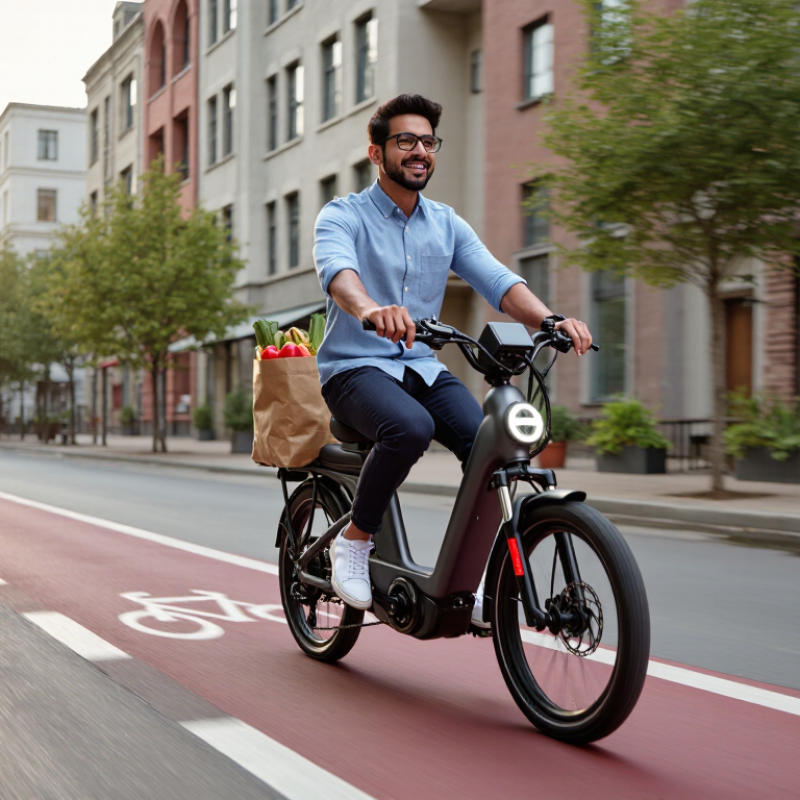
Urban commuting rarely follows a smooth route. Traffic queues, crowded buses, steep streets, and sudden rain can turn a short trip into a tiring routine. An electric city bike offers pedal assistance, helping riders move steadily through stop-and-go traffic without arriving as exhausted. Hills and longer distances can feel more manageable, too. But assistance does not erase urban risks.
A good fit depends on your route, storage, and charging options. For daily use, check the bike’s weight, riding position, and how easily its battery can be removed. A step-through frame can make frequent stops simpler. Lights, fenders, and a rear rack are practical in changing weather and for carrying work items. Battery range varies with hills, temperature, rider effort, and load. That detail is easy to overlook. It is also unwise to assume a bike will replace every trip; bad weather, secure parking, and maintenance still matter.
Tips: Test ride on a route with a hill and a few stops. Check that the brakes feel predictable, the lights are visible, and charging fits your routine. Leave room for a learning curve.
| Commuting Dimension | Urban Challenge | Conventional City Bike | Electric City Bike | Practical Commuting Benefit |
|---|---|---|---|---|
| Stop-and-go traffic | Frequent stops, queues, and slow-moving traffic can make road journeys unpredictable. | Can use suitable cycling routes and avoid many motor-vehicle queues, but acceleration depends entirely on rider effort. | Pedal assistance helps riders accelerate more easily after stops, while still requiring the rider to pedal on many models. | Can make cycling feel more manageable on routes with repeated starts and stops. |
| Hills and bridges | Inclines can increase exertion and may make some routes less appealing for everyday travel. | Requires greater physical effort on climbs, especially with a loaded bag or cargo. | Motor assistance can reduce the effort needed on climbs; the level of support depends on the bike and settings. | May help riders maintain a more comfortable pace on hilly routes. |
| Typical trip distance | Longer urban journeys can be tiring by bicycle, while driving and public-transport times depend on traffic, routes, and connections. | Well suited to short and moderate trips for riders comfortable with the required effort. | Assistance can make moderate-distance trips feel less strenuous. Battery range varies with terrain, rider and cargo weight, temperature, assist level, and riding style. | Can extend the distance some riders are willing or able to cycle; check the route and expected range before relying on a particular battery charge. |
| Battery and charging | Electric assistance depends on a charged battery and access to secure charging and storage. | No battery charging is needed. | Many city e-bikes use batteries in roughly the 300–700 Wh range; charging time depends on battery size, charger, and starting charge. | Estimate daily distance and charging access when choosing a bike; published range figures are not guaranteed for every ride. |
| Physical effort and arrival comfort | Commuters may want to avoid arriving overly tired or sweaty, particularly on warm days or longer journeys. | Rider effort varies with fitness, speed, terrain, and weather. | Adjustable assistance can reduce pedaling effort, although the rider still contributes effort on pedal-assist models. | Offers more control over exertion, which can make cycling easier to fit into a workday. |
| Parking and storage | Secure bicycle parking may be limited, and e-bikes can be heavier and more valuable than basic bicycles. | Usually easier to lift and carry than an e-bike, though security is still important. | Often weighs more than a conventional bicycle because of its motor and battery; actual weight varies by design. | Plan for secure locking and storage, and check whether the bike can be carried or stored where needed. |
| Rules and speed assistance | Legal definitions, equipment rules, and permitted assistance speeds differ by jurisdiction and e-bike category. | Subject to local cycling and road rules. | For example, EU rules for many standard pedal-assist cycles end motor assistance at 25 km/h; US Class 1 and Class 2 definitions generally use a 20 mph assistance limit. Local rules may differ. | Check local regulations before buying or riding, especially for speed limits, throttle use, and where the bike may be ridden. |
| Best-fit use case | One commute can involve traffic, hills, limited parking, and changing weather or route conditions. | A practical choice when the route is manageable without motor assistance and low weight or simplicity is a priority. | A practical option when additional assistance is useful for hills, longer trips, or reducing exertion. | Choose based on route length, terrain, storage, budget, and local rules rather than assuming one bike type suits every commute. |
| Note: Battery capacity, range, weight, charging time, and permitted assistance vary by model and location. Treat ranges as general guidance and verify specifications and local regulations before purchase. | ||||
An electric city bike turns pedaling into a more manageable part of daily travel. When you press the pedals, sensors detect movement or effort and signal a motor to provide assistance. The exact response depends on the bike’s design and selected support level. You still pedal; the motor does not replace ordinary riding. That distinction matters at traffic lights and on crowded streets.
On a typical commute, assistance can make a gentle hill or headwind feel less demanding. A small display may show speed, battery level, and support settings, while the brakes let you slow or stop as needed. Start with a modest assistance level in busy areas. It can feel easier to control, especially when turning between parked cars. Keep an eye on the battery, too. Cold weather, steep routes, and frequent high assistance can reduce how far it lasts. I once assumed a nearly full charge would cover every errand; that was optimistic.
Daily comfort also depends on details beyond the motor. Adjust the saddle so your knees stay slightly bent at the bottom of a pedal stroke, and check tire pressure regularly. A rear rack can carry groceries, but heavy bags may affect handling. Take a short practice ride before relying on the bike for a tight work schedule. You may still arrive damp in the rain. Plan for that.
An electric city bike can make a crowded commute feel more predictable. In INRIX’s 2023 Global Traffic Scorecard, US drivers lost an average of 42 hours to congestion. An e-bike cannot remove traffic, but it can use bike lanes and quieter side streets. That matters when a short car trip turns into stop-and-go driving. The motor also helps on hills and into headwinds, while you still pedal. You arrive with less effort. Not effortlessly, though: rain, secure parking, and battery charging still shape the ride.
Cost depends on how often you ride and what you already own. AAA’s 2024 Your Driving Costs report put the average annual cost of owning and operating a new vehicle at $12,297 in the United States. That is not a direct comparison with an e-bike, but it shows why replacing some car trips can matter. Electricity and routine bike maintenance usually cost less than fuel and car upkeep. A battery replacement, however, can change the math. Check its warranty and expected service life before buying.
The environmental case is strong for short urban trips. A European Cyclists’ Federation life-cycle analysis estimated about 22 grams of carbon dioxide equivalent per passenger-kilometre for an e-bike, compared with 271 grams for a car. Those figures depend on assumptions, including electricity supply and vehicle occupancy. Still, replacing solo car journeys can reduce transport emissions and local exhaust pollution. Small trips add up. A missed charge can also mean reaching for the car, so the benefit depends on daily habits.
Why Choose an Electric City Bike for Urban Commuting?
Choosing the Right Electric City Bike for Urban Needs
Choosing the right electric city bike starts with your actual route, not the longest range printed on a product page. NACTO reported 133 million shared micromobility trips in the United States and Canada in 2023. That scale signals growing urban use, but it cannot tell you which bike fits your commute. Measure your daily distance, note steep streets, and consider where you will store and charge the bike.
For stop-and-go streets, responsive assistance and predictable brakes matter more than impressive top-speed claims. Test the bike on a hill with your usual bag or groceries; a light test ride can hide how it handles a real load. Check that the frame feels manageable at traffic lights and that the battery can be removed easily if indoor charging is necessary. A wider tire may soften rough pavement, though it can make the bike feel less nimble. I’d avoid treating any single specification as decisive; comfort is personal, and a perfect checklist can still lead to the wrong fit.
Tips: Confirm the bike fits your height, then test your route if possible. Ask about battery replacement costs and local servicing before buying. Leave room in your budget for a helmet, lights, and a sturdy lock. Small details count.
An electric city bike can make hills and headwinds less punishing, but it does not remove traffic risk. NHTSA’s Traffic Safety Facts: Bicyclists, 2022, recorded 1,105 bicyclist deaths in the United States, roughly 3% of traffic fatalities. This figure covers bicyclists generally, not e-bike riders alone. That distinction matters. Choose quieter streets, signal early, and use front and rear lights in low light. A helmet that fits snugly helps, but cannot prevent every crash.
Maintenance is manageable, though small checks prevent frustrating breakdowns. Before riding, check tire pressure and test both brakes. Listen for rubbing. E-bike weight can make a soft tire feel especially sluggish. Keep the chain clean and lightly lubricated, and have a mechanic inspect the brakes if stopping feels uneven. For charging, use the supplied charger and avoid damaged batteries. The U.S. Consumer Product Safety Commission recommends choosing micromobility products certified to relevant safety standards, including UL 2849 for e-bike electrical systems.
Tips: Test your commute route with your usual load and assist setting; real-world range varies. Carry a compact pump and repair kit. Check your lights before leaving. A small, honest inconvenience: the safest route may take longer, but rushing through busy intersections is a poor trade.
Safety consideration: At higher speeds, stopping distance increases substantially. These illustrative estimates assume a 1-second reaction time and steady braking at 3 m/s² on level, dry pavement. Actual distances vary with rider, brakes, tires, load, and road conditions. Check brakes and tire condition regularly, and allow extra space in traffic.
| Cookie | Duration | Description |
|---|---|---|
| cookielawinfo-checbox-analytics | 11 months | This cookie is set by GDPR Cookie Consent plugin. The cookie is used to store the user consent for the cookies in the category "Analytics". |
| cookielawinfo-checbox-analytics | 11 months | This cookie is set by GDPR Cookie Consent plugin. The cookie is used to store the user consent for the cookies in the category "Analytics". |
| cookielawinfo-checbox-analytics | 11 months | This cookie is set by GDPR Cookie Consent plugin. The cookie is used to store the user consent for the cookies in the category "Analytics". |
| cookielawinfo-checbox-functional | 11 months | The cookie is set by GDPR cookie consent to record the user consent for the cookies in the category "Functional". |
| cookielawinfo-checbox-functional | 11 months | The cookie is set by GDPR cookie consent to record the user consent for the cookies in the category "Functional". |
| cookielawinfo-checbox-functional | 11 months | The cookie is set by GDPR cookie consent to record the user consent for the cookies in the category "Functional". |
| cookielawinfo-checbox-others | 11 months | This cookie is set by GDPR Cookie Consent plugin. The cookie is used to store the user consent for the cookies in the category "Other. |
| cookielawinfo-checbox-others | 11 months | This cookie is set by GDPR Cookie Consent plugin. The cookie is used to store the user consent for the cookies in the category "Other. |
| cookielawinfo-checbox-others | 11 months | This cookie is set by GDPR Cookie Consent plugin. The cookie is used to store the user consent for the cookies in the category "Other. |
| cookielawinfo-checkbox-necessary | 11 months | This cookie is set by GDPR Cookie Consent plugin. The cookies is used to store the user consent for the cookies in the category "Necessary". |
| cookielawinfo-checkbox-necessary | 11 months | This cookie is set by GDPR Cookie Consent plugin. The cookies is used to store the user consent for the cookies in the category "Necessary". |
| cookielawinfo-checkbox-necessary | 11 months | This cookie is set by GDPR Cookie Consent plugin. The cookies is used to store the user consent for the cookies in the category "Necessary". |
| cookielawinfo-checkbox-performance | 11 months | This cookie is set by GDPR Cookie Consent plugin. The cookie is used to store the user consent for the cookies in the category "Performance". |
| cookielawinfo-checkbox-performance | 11 months | This cookie is set by GDPR Cookie Consent plugin. The cookie is used to store the user consent for the cookies in the category "Performance". |
| cookielawinfo-checkbox-performance | 11 months | This cookie is set by GDPR Cookie Consent plugin. The cookie is used to store the user consent for the cookies in the category "Performance". |
| viewed_cookie_policy | 11 months | The cookie is set by the GDPR Cookie Consent plugin and is used to store whether or not user has consented to the use of cookies. It does not store any personal data. |
| viewed_cookie_policy | 11 months | The cookie is set by the GDPR Cookie Consent plugin and is used to store whether or not user has consented to the use of cookies. It does not store any personal data. |