
Sorry. We did not find anything.
Choosing the right Carbon Steel Shaft is not a simple matter of selecting the strongest grade. The correct choice depends on load, rotation speed, environment, machining method, and expected service life. A shaft that performs well in a dry factory may fail quickly near saltwater, abrasive dust, or repeated impact. Small details matter. A keyway can create stress concentration. Poor alignment can produce uneven wear within weeks.
This guide presents 10 practical tips for evaluating a Carbon Steel Shaft before purchase or production. It considers steel grade, diameter, hardness, tensile strength, surface finish, corrosion protection, heat treatment, and dimensional tolerance. It also explains how shaft design affects maintenance, noise, vibration, and replacement costs. These points are based on common engineering practice and real workshop concerns, not attractive catalog language alone.
Metallurgist Dr. George Krauss wrote, “The properties of steels are determined by their microstructure.” That principle remains important when comparing normalized, quenched, tempered, or induction-hardened shafts. A harder surface is not always better. Excessive hardness may reduce toughness and make failure more sudden. That is easy to overlook.
Before choosing, measure the actual operating conditions. Record torque, bending load, speed, temperature, and contamination. Ask for material certificates and dimensional inspection records. If the supplier cannot explain the grade or heat treatment, pause. Do not guess.
Even careful selection has limits. Real equipment may behave differently from calculations. Testing a sample under realistic load can reveal problems early. The following tips help turn a general specification into a safer, more reliable Carbon Steel Shaft choice.
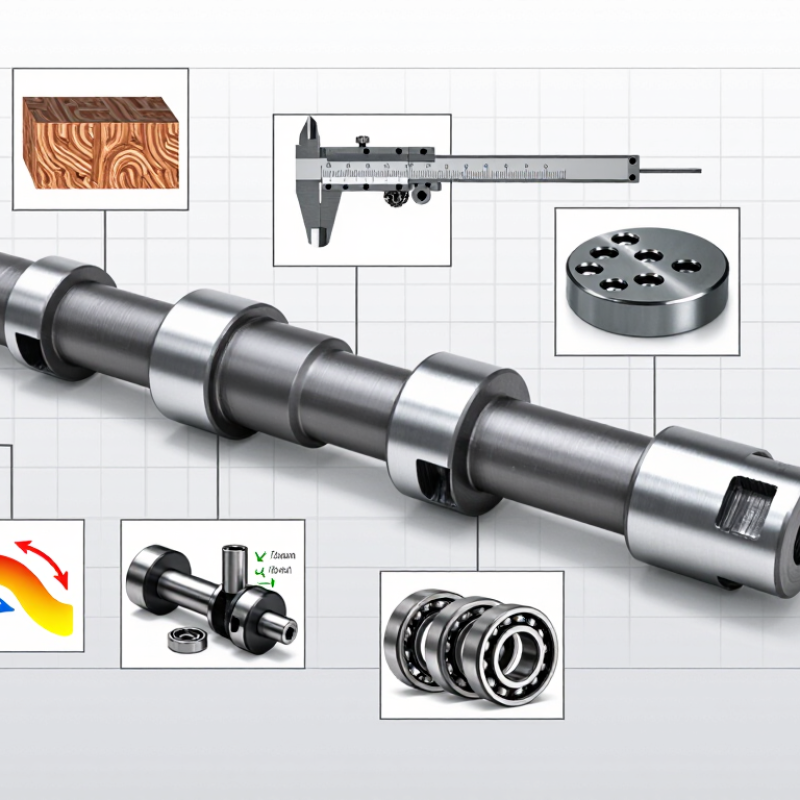
Choosing a carbon steel shaft starts with its job, not its diameter. Is it transmitting torque, carrying a pulley, supporting a rotor, or guiding a reciprocating load? The answer sets the real design target. A conveyor shaft may face steady torque. A pump shaft may see torsional pulses, bending, seal friction, and misalignment. The U.S. Department of Energy’s 2014 United States Industrial Electric Motor Systems Market Opportunities Assessment reported that motor-driven systems used about 68% of industrial electricity. That figure matters. Small efficiency losses can become large operating costs.
Record speed, torque, radial load, axial load, duty cycle, temperature, humidity, and contamination. Measure, do not guess. For rotating equipment, calculate combined bending and torsional stress at keyways, shoulders, and threads. Keyways deserve suspicion. They interrupt the shaft surface and raise local stress. ISO 281:2007 defines L10 bearing life as the life reached by 90% of identical bearings under stated conditions. This benchmark connects shaft alignment with bearing performance, but it does not replace fatigue analysis.
Select grade and heat treatment after defining operating conditions. Low-carbon steel may suit moderate loads and easy machining. Higher-strength grades can help, yet hardness may reduce toughness or complicate repair welding. Check corrosion exposure carefully. Carbon steel loses section in wet, salty, or chemically active areas. In field reviews, I have seen polished shafts fail beside an ignored seal. Appearance misleads. Leave room for startup shocks, imperfect alignment, and maintenance errors. I would also question the stated load history, because real machines rarely follow a clean duty cycle. Confirm it with vibration records, torque measurements, and inspection evidence before final sizing.
Define the shaft’s role and operating conditions before selecting a grade. The chart compares approximate tensile-strength ranges for commonly used carbon-steel shaft materials in normalized or hot-rolled conditions. Actual values vary with heat treatment, section size, manufacturing process, and applicable material standards.
10 Tips for Choosing the Right Carbon Steel Shaft
Compare Shaft Grades, Strength, Hardness, and Flexibility
Choosing a carbon steel shaft starts with its working load, not its price. SAE 1045 offers moderate strength and good machinability. In normalized condition, published data commonly places its tensile strength near 565 MPa. SAE 4140 can exceed 850 MPa after suitable heat treatment, according to ASM Handbook data. These figures are not interchangeable. Heat treatment, diameter, and test direction can change performance.
Check the grade against recognized standards. ASTM A29/A29M defines chemical and manufacturing requirements for many carbon and alloy steel bars. ASTM A370 describes mechanical testing methods, including tensile and hardness tests. A shaft may pass a tensile test yet fail from repeated bending. Fatigue matters. Inspect shoulders, keyways, and surface marks with care. Small grooves can concentrate stress.
Hardness improves wear resistance, but excessive hardness can reduce flexibility and complicate machining. Rockwell hardness readings should be taken on a clean, properly prepared surface. Compare the result with the supplier’s material certificate and heat-treatment record. Measure it twice. A practical fit may require a softer core and harder surface, but that choice needs engineering review. I would not select a grade from strength alone; stiffness, shock loading, corrosion exposure, and straightness deserve equal attention. The difficult part is accepting that the “strongest” shaft may be the wrong shaft.
10 Tips for Choosing the Right Carbon Steel Shaft
Select the Proper Shaft Diameter, Length, and Tolerance
A carbon steel shaft should be selected from its working load, not from appearance. Diameter affects bending strength, torque capacity, bearing fit, and surface speed. Measure torque, bending force, and the unsupported span before choosing a size. A thick shaft can still deflect when the overhang is long. Deflection matters.
Check keyways, shoulders, threads, and grooves carefully. These features remove material and create stress concentrations. A 25 mm shaft may perform differently after a deep keyway is machined. Keep the shaft only as long as the assembly requires. Extra length adds weight, vibration, and alignment risk. Define the overall length, usable length, and reference ends clearly. Small details help.
Tolerance should match the function, not habit. Bearing seats usually need tighter diameter control than open rotating sections. Specify diameter tolerance, straightness, roundness, concentricity, and surface finish separately. A general ±0.1 mm note may hide a serious fit problem. Use calibrated micrometers at several locations, especially near bearing seats. In workshop inspections, I have seen correct calculations fail because measurements were taken at one point only. My early selections sometimes focused too much on strength. Fit and manufacturing variation deserve equal attention.
10 Tips for Choosing the Right Carbon Steel Shaft
Surface finish is more than appearance. A rough shaft can trap moisture, accelerate wear, and damage seals during rotation. Specify the target roughness value, such as Ra, and verify it with a calibrated tester. ISO 21920 provides a current framework for surface-texture measurement. In practical inspections, polished areas may look excellent while hidden grooves remain near shoulders or keyways.
Corrosion protection deserves equal attention. The NACE IMPACT study estimated that corrosion costs about 3.4% of global gross domestic product, or roughly 2.5 trillion US dollars annually. That figure makes a thin protective coating worth examining carefully. Ask whether the shaft uses plating, oil preservation, phosphate treatment, or another controlled process. Check coating thickness, adhesion, and damaged edges. Salt-spray results can help compare batches, but they do not perfectly predict field life. Environment matters.
Manufacturing quality appears in the records, not only on the surface. Request material certificates, heat-treatment results, dimensional reports, and hardness data. Confirm straightness at several points, especially after machining or coating. ISO 9001-based quality systems can improve traceability, but certification alone proves little about one shaft. I have seen attractive parts fail because inspection ignored a small runout error. That mistake is easy to repeat. Examine transition radii, threads, keyways, and end faces under strong lighting. A careful supplier should explain rejected parts, not hide them.
Choosing a carbon steel shaft starts with compatibility, not price. Confirm diameter, length, keyway size, thread details, and torque requirements. Check the shaft against the mating hub, bearing, coupling, and operating speed. A small mismatch can cause vibration, uneven wear, or early failure. Measure the existing part when possible. Drawings are useful, but they can contain outdated dimensions.
Safety standards also need careful attention. Ask for material certificates, hardness data, straightness tolerances, and inspection records. Confirm that testing follows recognized industrial standards suitable for the application. Do not accept a generic “tested” statement. Request clear documentation. Consider corrosion exposure, temperature, shock loading, and guarding requirements. A shaft that works in a dry workshop may fail near moisture or chemicals. This detail is often underestimated.
Cost includes more than the purchase price. Compare machining, coating, delivery, installation, and replacement risks. A cheaper shaft may require extra fitting or more frequent maintenance. I have seen buyers overlook packaging damage during transport. It was avoidable. Supplier reliability matters just as much. Review production capacity, traceability, quality controls, sample approval, and response times. Ask how nonconforming parts are handled. Verify lead times in writing. If the supplier avoids technical questions, pause before ordering. A practical trial order can reveal accuracy, communication, and consistency better than a polished catalogue.
| No. | Decision Area | What to Verify | Reliable Technical Benchmark or Data | Recommended Selection Action | Relevant Reference |
|---|---|---|---|---|---|
| 1 | Load and Torque Compatibility | Confirm the shaft diameter, unsupported length, transmitted torque, bending moment, speed, and duty cycle. | For a solid round shaft, bending stress can be estimated as σ = 32M/(πd³), while torsional shear stress can be estimated as τ = 16T/(πd³). Combined loading may be checked using σv = √(σ² + 3τ²). | Use the actual load spectrum rather than the motor’s rated power alone. Include shock loads, startup torque, and an engineering safety factor. | Classical strength-of-materials shaft design equations |
| 2 | Material Grade | Verify the carbon content, heat-treatment condition, mechanical properties, and availability of a material test certificate. | Common medium-carbon grades such as 1045-type steel generally provide higher strength and hardness than low-carbon grades, but the actual properties depend strongly on hot-rolled, cold-drawn, normalized, or quenched-and-tempered condition. | Specify the exact grade, condition, minimum tensile strength, yield strength, elongation, and hardness range on the purchase specification. | ASTM A108; EN 10083 material-designation practice |
| 3 | Dimensional Fit | Check shaft diameter, bearing bore, keyway dimensions, shoulder geometry, thread details, and mating-part tolerances. | ISO 286 defines limits and fits. For example, an h6 shaft tolerance has an upper deviation of zero, with the lower deviation determined by the IT6 tolerance grade. | Define the shaft tolerance together with the mating bore tolerance, such as a documented H7/h6 or another fit selected for the actual rotating application. | ISO 286-1 and ISO 286-2 |
| 4 | Straightness and Runout | Verify total indicated runout, straightness, shoulder concentricity, and journal alignment over the complete finished length. | There is no single runout limit suitable for every shaft. The acceptable value depends on rotational speed, bearing clearance, shaft length, and vibration sensitivity. Higher speeds require tighter control. | Place a measured runout limit on the drawing and identify the datum surfaces, inspection locations, measuring method, and maximum rotational speed. | Application-specific drawing requirements; ISO 1101 GPS principles |
| 5 | Dynamic Balance and Speed | Determine whether the shaft carries an eccentric mass, pulley, coupling, fan, gear, or other rotating component. | ISO 21940 uses balance quality grades expressed as residual specific unbalance. A lower grade number represents a stricter balance requirement; the correct grade depends on rotor speed and machine sensitivity. | Specify the maximum operating speed, balance quality grade, correction plane, residual unbalance limit, and balance report requirements. | ISO 21940-11 |
| 6 | Safety and Failure Prevention | Review fracture risk, rotating guards, pinch points, overspeed conditions, keyway stress concentration, and possible ejection of broken parts. | ISO 12100 addresses machinery risk assessment and risk reduction. ISO 13849-1 addresses safety-related control systems; neither standard alone determines the shaft diameter or material grade. | Complete a documented risk assessment and use guards, interlocks, overspeed protection, and fail-safe controls where the application requires them. | ISO 12100; ISO 13849-1 |
| 7 | Fatigue and Surface Condition | Check cyclic bending, reversing torque, keyways, snap-ring grooves, threads, shoulders, fillets, surface finish, and residual stresses. | Fatigue strength is not determined by tensile strength alone. Stress concentrations at keyways and sharp shoulders can significantly reduce fatigue performance, while improved fillets and suitable surface finish can increase resistance. | Use generous fillet radii, avoid abrupt section changes, specify journal surface finish, and perform fatigue analysis for repeated or reversing loads. | Machine-design fatigue and stress-concentration methods |
| 8 | Corrosion Protection | Assess humidity, water exposure, salt, chemicals, storage duration, and contact with dissimilar metals. | Unprotected carbon steel can rust in the presence of moisture and oxygen. Corrosion resistance must therefore be provided through coating, plating, painting, oiling, controlled storage, or a suitable environmental design. | Specify the protection system, coating thickness where applicable, masking areas for bearing fits, post-treatment dimensions, and corrosion-performance requirements. | ISO 12944 coating-system principles; application-specific corrosion specification |
| 9 | Total Cost and Lead Time | Compare material, machining, heat treatment, keyway and thread work, straightening, balancing, inspection, packaging, freight, and replacement cost. | The lowest purchase price may not be the lowest total cost. Tight tolerances, special heat treatment, deep grinding, balancing, and short delivery times normally add manufacturing cost. | Request comparable quotations using the same drawing revision, material condition, tolerance, inspection plan, packaging requirement, quantity, and delivery term. | Total-cost-of-ownership purchasing practice |
| 10 | Supplier Reliability and Inspection | Verify process control, traceability, production capacity, corrective-action history, inspection equipment, and continuity of supply. | An ISO 9001-certified quality-management system indicates a documented management system but does not by itself guarantee that every shaft conforms. EN 10204 Type 3.1 certificates provide inspection results for the supplied material batch. | Require lot identification, material certificates, dimensional and hardness reports, calibration records, nonconformance procedures, sample approval, and a defined change-notification process. | ISO 9001; EN 10204; ISO 2859-1 sampling principles |
| Cookie | Duration | Description |
|---|---|---|
| cookielawinfo-checbox-analytics | 11 months | This cookie is set by GDPR Cookie Consent plugin. The cookie is used to store the user consent for the cookies in the category "Analytics". |
| cookielawinfo-checbox-analytics | 11 months | This cookie is set by GDPR Cookie Consent plugin. The cookie is used to store the user consent for the cookies in the category "Analytics". |
| cookielawinfo-checbox-analytics | 11 months | This cookie is set by GDPR Cookie Consent plugin. The cookie is used to store the user consent for the cookies in the category "Analytics". |
| cookielawinfo-checbox-functional | 11 months | The cookie is set by GDPR cookie consent to record the user consent for the cookies in the category "Functional". |
| cookielawinfo-checbox-functional | 11 months | The cookie is set by GDPR cookie consent to record the user consent for the cookies in the category "Functional". |
| cookielawinfo-checbox-functional | 11 months | The cookie is set by GDPR cookie consent to record the user consent for the cookies in the category "Functional". |
| cookielawinfo-checbox-others | 11 months | This cookie is set by GDPR Cookie Consent plugin. The cookie is used to store the user consent for the cookies in the category "Other. |
| cookielawinfo-checbox-others | 11 months | This cookie is set by GDPR Cookie Consent plugin. The cookie is used to store the user consent for the cookies in the category "Other. |
| cookielawinfo-checbox-others | 11 months | This cookie is set by GDPR Cookie Consent plugin. The cookie is used to store the user consent for the cookies in the category "Other. |
| cookielawinfo-checkbox-necessary | 11 months | This cookie is set by GDPR Cookie Consent plugin. The cookies is used to store the user consent for the cookies in the category "Necessary". |
| cookielawinfo-checkbox-necessary | 11 months | This cookie is set by GDPR Cookie Consent plugin. The cookies is used to store the user consent for the cookies in the category "Necessary". |
| cookielawinfo-checkbox-necessary | 11 months | This cookie is set by GDPR Cookie Consent plugin. The cookies is used to store the user consent for the cookies in the category "Necessary". |
| cookielawinfo-checkbox-performance | 11 months | This cookie is set by GDPR Cookie Consent plugin. The cookie is used to store the user consent for the cookies in the category "Performance". |
| cookielawinfo-checkbox-performance | 11 months | This cookie is set by GDPR Cookie Consent plugin. The cookie is used to store the user consent for the cookies in the category "Performance". |
| cookielawinfo-checkbox-performance | 11 months | This cookie is set by GDPR Cookie Consent plugin. The cookie is used to store the user consent for the cookies in the category "Performance". |
| viewed_cookie_policy | 11 months | The cookie is set by the GDPR Cookie Consent plugin and is used to store whether or not user has consented to the use of cookies. It does not store any personal data. |
| viewed_cookie_policy | 11 months | The cookie is set by the GDPR Cookie Consent plugin and is used to store whether or not user has consented to the use of cookies. It does not store any personal data. |