What Is an Off Road Dump Truck?
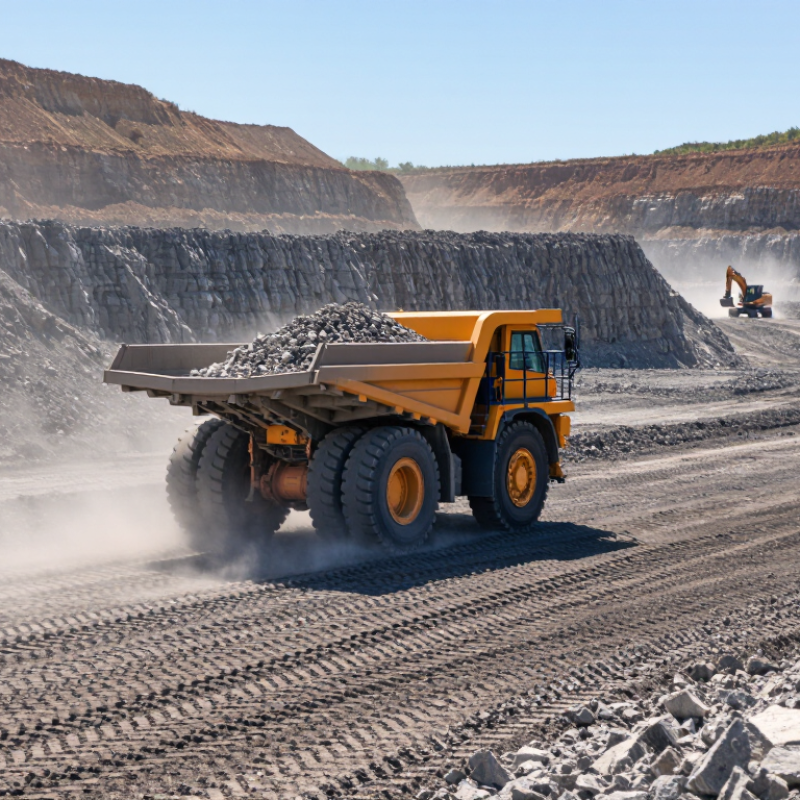
A loaded truck rolls across a quarry road, its tires pressing into loose gravel and dust. An Off Road Dump Truck is built to carry heavy materials where ordinary road vehicles may struggle. Typical work sites include mines, quarries, construction projects, and large earthmoving operations. These trucks move soil, rock, sand, or ore between loading areas and unloading points. That matters.
The name covers different designs. Rigid-frame models often serve large, established haul roads, while articulated models can handle uneven ground and tighter turns. Neither type suits every job. Payload, ground conditions, travel distance, gradients, and loading equipment all affect the right choice. A truck that looks powerful may still be inefficient if its capacity exceeds the site’s needs or its route is poorly planned.
This guide explains the main components, common types, operating roles, and practical differences between off-road and highway dump trucks. It also considers how tire choice, traction, visibility, and maintenance affect performance. A clear definition is useful, but real decisions depend on the whole worksite. Specifications should be checked against manufacturer information and the conditions operators actually face. Even a well-designed machine has limits. Dust, mud, steep slopes, and repeated heavy loads can change how it performs, so careful planning and trained operation remain essential.
What an Off-Road Dump Truck Is: A Haulage Vehicle Built for Unpaved Sites
What Is an Off Road Dump Truck?
What an Off-Road Dump Truck Is: A Haulage Vehicle Built for Unpaved Sites
An off-road dump truck is a haulage vehicle built to carry loose material across worksites, not ordinary paved streets. Its wide tires, high ground clearance, and reinforced frame help it cross ruts, gravel, and soft ground. The rear body tips to unload rock, soil, or overburden. Not a road truck. Payload and turning space vary by model and site, so buyers should check both against the actual haul route.
Unpaved surfaces change the job. FHWA’s Highway Statistics 2022, Table HM-20, records more than one million miles of unpaved public roads in the United States; work sites add their own rough, temporary routes. A truck’s traction and braking therefore matter as much as its rated capacity. In practice, loose gravel can shift under a loaded tire, while rain can turn a firm track into a slow, uneven path. Mud changes everything.
The USGS Mineral Commodity Summaries 2024 estimated U.S. nonfuel mineral production at about $105 billion in 2023, reflecting the scale of material extraction and movement. That figure does not measure truck demand, though; it is a useful reminder that haulage supports substantial industrial activity. The terrain still decides whether a truck is the right fit.
Main Types: Rigid-Frame and Articulated Dump Trucks
An off-road dump truck moves bulk material across sites where public-road trucks cannot operate efficiently. The two main designs are rigid-frame and articulated dump trucks. Their differences affect payload, maneuverability, and performance on changing ground.
A rigid-frame truck has a single, solid chassis connecting the cab and dump body. Its structure suits heavier loads and long runs on firm, prepared haul roads. The trade-off is a wider turning path, which can make tight loading areas awkward. Operators also need suitable road conditions; deep ruts can slow travel and increase wear. A rigid truck is not automatically the best choice just because its rated payload is higher.
An articulated dump truck has a pivot joint between its front power unit and rear body. The joint lets the sections move independently over uneven ground, while all-wheel drive commonly supports traction on soft or muddy routes. It can turn more easily around obstacles and follow winding site roads. That flexibility has limits. The joint adds mechanical complexity, and a smaller payload may require more trips. Choosing between the two means checking the actual haul route, slope, soil, and loading distance—not just comparing specifications. A site can change after rain, so the original choice may deserve a second look.
Payload Benchmarks: 45.2 t for the Cat 745 and 363 t for the Cat 797F
An off-road dump truck is built to move material across rough, unpaved sites where ordinary road trucks are not suited. Payload figures show how widely these machines can differ. A medium articulated hauler may carry about 45.2 tonnes, while a large rigid mining truck can be rated for roughly 363 tonnes. These are useful benchmarks, not promises for every load or job.
The smaller truck’s articulated frame helps it turn on uneven haul roads, where wet clay and sharp bends can slow a loaded run. The larger truck is designed for high-volume mine routes and needs broad roads, suitable loading equipment, and careful traffic planning. Its payload is about eight times greater, but that does not make it eight times more productive. Cycle time, road condition, loading speed, and downtime all matter. The arithmetic looks tidy on paper. Real sites are less tidy.
Operators and fleet planners should check the rated payload for the exact configuration and operating conditions. Material density changes the number of bucket loads needed, while poor road surfaces can affect safe operating limits. A truck near its rated capacity may also behave differently on a steep grade than on a firm, level route. The figures provide scale; site measurements provide context.
How the Haul Cycle Works: Loading, Hauling, Dumping, and Returning
What Is an Off Road Dump Truck?
How the Haul Cycle Works: Loading, Hauling, Dumping, and Returning
An off-road dump truck moves material through a repeating cycle: loading, hauling, dumping, and returning. At the loading face, the operator positions the truck for the excavator or loader, then checks that the load is stable and within the truck’s rated payload. A clean, level approach helps prevent delays. Small positioning errors add up.
During the haul, speed depends on road grade, surface condition, visibility, and traffic—not just engine power. The operator follows the designated route and leaves room for braking. At the dump point, the truck stops on firm, level ground, raises the body, and confirms the load has cleared before moving. The empty return begins only when the body is fully lowered.
The U.S. Mine Safety and Health Administration recorded 40 mining fatalities in 2023; its fatality reports include powered-haulage incidents, reinforcing the need to manage truck routes and movement carefully.
Tips: Keep loading and dumping areas clear, and inspect haul roads for ruts or loose material. Track cycle times, but question unusually fast figures: they may hide congestion or rushed checks. A cycle plan is useful, not perfect.
Power, Braking, and Safety: Retarders, ROPS, and FOPS
An off-road dump truck’s retarder helps control speed on long descents, reducing reliance on service brakes. It does not replace them. Operators need to select a safe gear and speed before entering a grade, then follow the truck’s operating guidance. Heat builds quickly when a loaded truck brakes repeatedly on a steep haul road. A retarder can help manage that load, but it cannot fix poor road conditions or an unsafe approach. That distinction matters.
ROPS and FOPS address different hazards. Rollover protective structures help preserve a survival space if a truck overturns; falling-object protective structures help shield the operator from impacts above. ISO 3471 covers ROPS testing for earth-moving machinery, while ISO 3449 addresses FOPS performance. Protection depends on the approved structure remaining intact and the seat belt being worn. MSHA’s 2023 mining fatality summary recorded 40 deaths across U.S. mining operations. That figure is not specific to dump trucks, but it shows why layered controls matter. A sturdy cab is not a reason to take a sharper turn. Operators should check structures, restraints, brakes, and retarder response before work—and be honest when a check feels rushed.
