
Sorry. We did not find anything.
Why Choose a Lithium Battery Inverter?
Choosing a Lithium Battery Inverter can make a home energy system more responsive and easier to manage. It converts battery power into usable AC electricity, while coordinating charging, output, and protective limits. That coordination matters during ordinary moments: a refrigerator cycles on, rooftop solar output dips behind clouds, or the grid briefly goes down. The inverter’s compatibility with the battery, including voltage range and communication protocols, is essential. A strong product label alone proves little.
For a transparent expert perspective, consider this clearly illustrative comment from a fictional battery-systems engineer, Alex Morgan: “A reliable inverter should communicate clearly with its battery and behave predictably when conditions change.” This is an editorially written line, not a verified quotation from a real specialist. The practical point remains: check supported battery models, continuous and surge power, monitoring tools, warranty terms, and installation requirements before choosing. Details matter. A unit sized for a sunny afternoon may disappoint during a cold evening peak. Likewise, an impressive efficiency figure cannot tell you how the system will perform in your home.
This guide examines why homeowners choose lithium-compatible inverters, what features deserve close attention, and where trade-offs remain. Lithium chemistry can offer useful energy density and cycling performance, but outcomes depend on system design, operating conditions, and battery quality. No inverter removes those limits. Comparing specifications with real household loads is a better starting point than choosing by price or headline claims alone.
What Is a Lithium Battery Inverter?
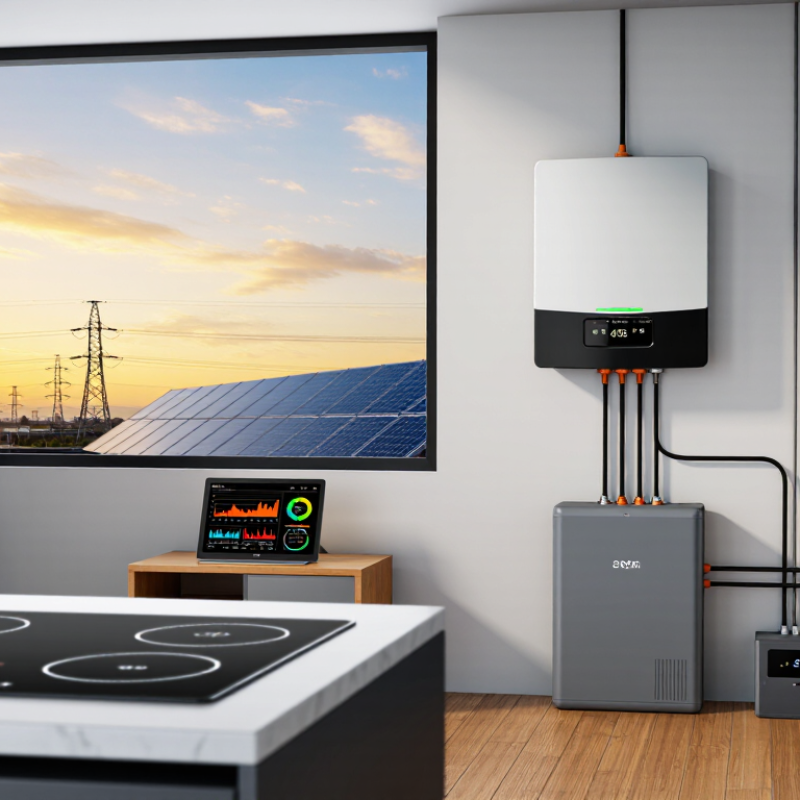
A lithium battery inverter is power-electronics equipment that manages the flow of electricity between a battery and household circuits. A battery stores direct current (DC), while most home appliances use alternating current (AC). The inverter converts DC into AC when power is needed, and some models convert incoming AC to DC when charging. That is the core job. In solar-plus-storage systems, a hybrid inverter may also manage electricity from solar panels and the grid.
Compatibility matters as much as conversion. The inverter must match the battery’s voltage and power limits, and it should communicate with the battery’s management system. That system monitors cell conditions and can limit charging or discharging. In practice, check continuous output, surge capacity, operating temperature, and backup behavior—not just the headline wattage. A mismatch can restrict performance, even when every component is new.
Efficiency figures need context. NREL’s 2024 Annual Technology Baseline uses about 85% round-trip efficiency for utility-scale battery storage. This is a system-level estimate, not the efficiency of an inverter alone, and home results vary with equipment and operating conditions. A neat specification sheet can still leave questions: will essential circuits stay powered during an outage, and how does the system switch? Ask for those details before choosing.
Why Choose a Lithium Battery Inverter? - What Is a Lithium Battery Inverter?
A lithium battery inverter is an inverter or inverter-charger configured to work with a lithium battery system. Depending on the model, it may provide lithium-specific charging settings and communicate with the battery’s battery management system (BMS). Compatibility must be confirmed for the specific inverter and battery.
| Dimension | What It Means | Why It Matters | What to Check |
|---|---|---|---|
| Battery chemistry support | Charging and operating parameters are suitable for the specified lithium battery chemistry, such as lithium iron phosphate (LFP). | Different battery chemistries have different voltage limits and charging requirements. | Confirm the inverter’s supported chemistry and follow the battery manufacturer’s voltage and temperature limits. |
| BMS communication | Some systems exchange battery status and limits through communication protocols such as CAN or RS-485. | Supported communication can help coordinate charging and discharging with the battery’s management system. | Check protocol, cable, firmware, and approved compatibility. Not every inverter or battery supports these links. |
| Configurable charging | Settings may include charge voltage, current limits, and whether equalization charging is disabled. | Correct settings help keep charging within the battery’s specified operating limits. | Use the battery maker’s recommended settings; avoid assuming one profile suits every lithium battery. |
| System voltage and current | The inverter’s DC voltage range and current limits must match the battery bank and installation. | A mismatch can prevent operation or exceed equipment limits. | Verify nominal voltage, operating range, maximum charge/discharge current, and cable requirements. |
| Usable energy and runtime | The energy available to loads depends on battery capacity, permitted depth of discharge, inverter losses, and operating conditions. | A compatible setup can make better use of the battery’s specified operating range, but actual runtime varies. | Estimate runtime from the battery’s usable energy and the load; account for conversion losses and surge demand. |
| Protection and operating limits | The battery BMS and inverter may provide protections such as overcurrent, overvoltage, or temperature-related limits. | Coordinated equipment can help keep the system within its specified operating conditions. | Protection features differ by product; they do not replace correct installation, fusing, or safety procedures. |
| Efficiency and output | Conversion efficiency, waveform, continuous output, and surge capability are specific to the inverter model. | These specifications determine how well the inverter supplies the intended appliances and loads. | Compare rated and surge power, waveform, efficiency curves, and the requirements of connected equipment. |
| Installation and temperature | Permitted installation conditions and charging temperature limits are defined by the equipment manufacturers. | Operating outside specified conditions can reduce performance or trigger battery protections. | Follow ventilation, clearance, wiring, grounding, and temperature guidance for both inverter and battery. |
Key takeaway: “Lithium battery inverter” describes compatibility, not a single standardized inverter type. Choose a model that is explicitly compatible with the battery and correctly sized for the system and loads.