
Sorry. We did not find anything.
Choosing carbon fiber sheets is not about chasing a premium material. It is about solving a specific design problem with less weight, controlled stiffness, or improved corrosion resistance. A sheet can feel remarkably light in your hands. Its performance, however, depends on fiber direction, thickness, resin system, and manufacturing quality.
The market is growing, but market size alone does not prove a sheet suits your project. MarketsandMarkets estimated the global carbon fiber market at USD 5.5 billion in 2023 and forecast USD 9.6 billion by 2028. That report covers the broader carbon fiber market, not sheets alone. For practical selection, composites researcher Dr. Stephen W. Tsai’s published design work points to a more useful principle: align reinforcement with the loads the part must carry. Treat that as design guidance, not a substitute for testing.
That means checking the sheet’s data sheet before cutting. Compare fiber orientation, laminate thickness, tensile properties, resin compatibility, and surface finish. A panel loaded along its fibers may perform very differently from one loaded across them. Edges also deserve attention; poorly supported drilling can damage the laminate. Not magic.
This guide explains where carbon fiber sheets offer real value, how to compare grades, and what trade-offs to examine. They can reduce mass in brackets, covers, and equipment panels. They may also cost more and require careful machining. Choose by measured requirements, not appearance alone. A glossy weave can look convincing. It cannot confirm the layup inside.
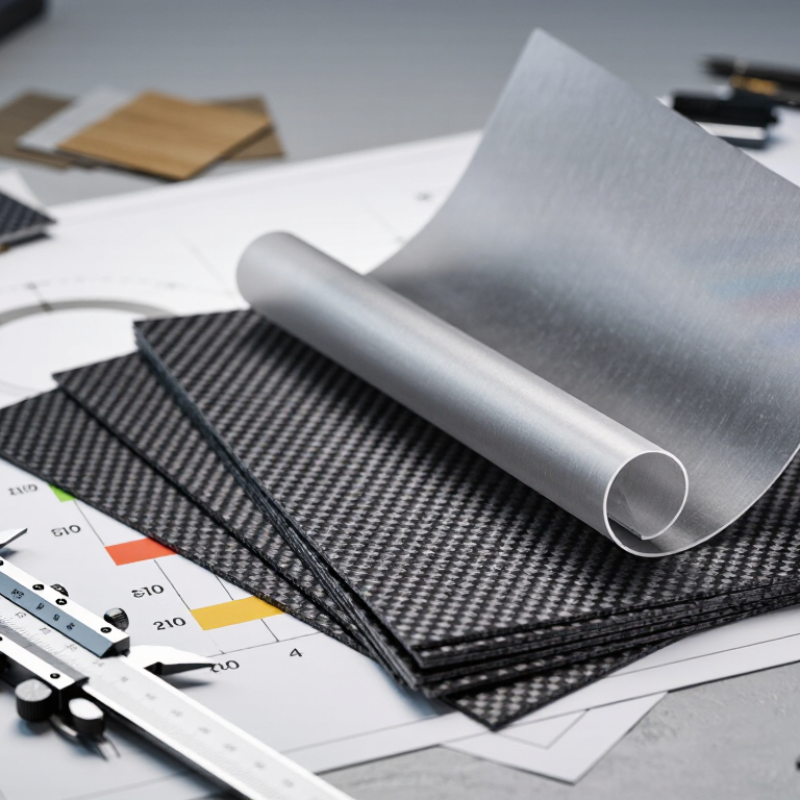
Carbon fiber sheets are flat composite panels made from fine carbon filaments held in a polymer resin. The fibers may run in one direction, cross in a woven pattern, or combine several orientations. Their arrangement affects stiffness and how the sheet responds to loads. Resin binds the fibers and helps transfer force between them. Look closely, and a woven sheet may show a small checkerboard texture beneath its surface finish.
Manufacturing often begins by arranging dry fabric or resin-coated fiber layers in a mold. In a wet-layup process, resin is applied during assembly; prepreg material already contains measured resin. Layers are placed at selected angles, then cured with controlled heat and pressure. Some processes use a vacuum bag to help remove trapped air. The cured panel is trimmed and inspected for thickness, surface defects, and inconsistencies. The details matter. A glossy face does not prove that a sheet is suitable for every load or environment. Check its stated thickness, fiber direction, and test data before choosing it. I have seen specifications overlooked because two panels looked nearly identical. Not always. Construction and quality can vary.
A carbon-fiber sheet gets its strength from thousands of fine fibers held in a resin matrix. The fibers carry most of the load; the resin keeps them aligned and transfers stress between them. Orientation matters. A sheet is strongest along its fibers, not equally strong in every direction. Designers therefore stack layers at selected angles to handle real forces, such as bending around a mounting hole or vibration across a panel.
Weight is the practical advantage. ASM International’s engineering materials data place typical carbon/epoxy laminates near 1.5–1.6 g/cm³, compared with about 2.7 for aluminum and 7.8 for steel. The U.S. DRIVE Materials Technical Team Roadmap also identifies carbon-fiber composites as a route to substantial vehicle mass reduction. But lighter does not mean indestructible. A sharp edge can damage fibers, and hidden impact damage may be hard to spot. That part is easy to underestimate. In a workshop, cut edges need care, and drilled holes need thoughtful support. A thinner sheet may feel remarkably stiff in one direction, then flex in another. Material data helps narrow the choice; the actual layup, fixing points, and load path still deserve a test.
Representative specific tensile strength of selected engineering materials (tensile strength divided by density).
Using representative values, carbon-fiber composite offers high tensile strength relative to its low density. Actual properties vary by fiber direction, laminate design, alloy, and product; the composite value represents loading along the fibers.
Carbon fiber sheets can deliver high stiffness at relatively low weight, which matters when a panel must stay rigid without adding much mass. In a small equipment enclosure, that can mean easier handling and less load on its supports. The actual performance depends on the fiber direction, sheet thickness, and construction. A sheet with fibers running mainly one way may resist bending well in that direction, yet feel less rigid across it.
Direction matters.
For project design, check the load path before choosing a thickness. A mounting hole near an edge, for example, can create a stress point that a flat strength rating does not reveal. Carbon fiber also resists corrosion, but resin systems and service temperatures vary, so confirm the material’s specifications for the working environment.
Cutting and drilling need care; clean edges and suitable dust controls help protect both the part and the people making it.
A test piece is useful.
Still, it adds time, and teams may skip it under pressure. That is worth reconsidering when fit, finish, or repeated loading is important. The dark surface can look uniform, while hidden layup details differ.
Ask for clear technical data before relying on appearance alone.
When selecting carbon fiber sheets, begin with the load direction, not appearance. A woven sheet may suit multi-directional loads, while unidirectional material is designed to carry most force along its fibers. Check thickness, fiber orientation, resin type, and whether the sheet is solid or sandwich construction. A glossy finish can look impressive, but it does not confirm strength or suitability.
Weight can matter in mobile projects. The U.S. Department of Energy reports that reducing vehicle weight by 10% can improve fuel economy by about 6–8%. That figure applies to vehicles, not every carbon fiber application, but it shows why weight targets deserve attention. Also consider operating temperature, moisture, impact exposure, edge finishing, and how holes or cutouts affect the load path. One detail is easy to miss: carbon fiber conducts electricity, so keep it away from exposed electrical contacts where conductivity could create a hazard.
Tips: Ask for a datasheet showing fiber orientation, thickness tolerance, and test conditions. Match the panel to the actual load, then check a sample before ordering. I might be tempted to choose the stiffest option, but stiffness alone can be the wrong measure; cost, brittleness, and machining needs matter too.
| Why Choose Carbon Fiber Sheets for Your Project? — Factors to Consider When Selecting Carbon Fiber Sheets | |||
|---|---|---|---|
| Selection Factor | What to Consider | When Carbon Fiber Sheets May Be Suitable | Practical Checks Before Buying |
| Weight and stiffness | Carbon fiber composites can provide high stiffness for their weight, but actual performance depends on the fiber direction, resin system, laminate design, and thickness. | Useful when reducing component mass is important and the part can be designed around the material’s directional properties. | Compare the sheet’s areal weight, thickness, laminate construction, and published mechanical data with the requirements of the finished part. |
| Fiber orientation | Unidirectional laminates are strongest and stiffest mainly along the fiber direction. Woven and multi-directional laminates distribute properties across more than one direction. | Choose a directional laminate for loads that are well understood; consider a balanced multi-directional layup when loads come from several directions. | Check the stated fiber orientation and layup schedule. Do not assume that a sheet is equally strong in every direction. |
| Thickness and stiffness | Thickness affects bending stiffness, weight, fit, and edge details. A thicker sheet is not automatically the best choice for every design. | Appropriate when the required stiffness and available space can be met by a standard sheet thickness. | Confirm actual thickness tolerance, flatness, required cut size, and whether the part needs reinforcement or a different laminate. |
| Strength and loading | Strength varies with laminate design and loading type. Impact, holes, cut edges, joints, and concentrated loads can reduce the performance of a finished component. | Suitable for engineered parts where loads and attachment details can be assessed before fabrication. | Review tensile, flexural, and compression data where relevant. For safety-critical parts, use qualified engineering analysis and testing. |
| Temperature and environment | The resin matrix influences service temperature, moisture resistance, and chemical compatibility. Carbon fiber itself does not determine all environmental limits. | Useful when the selected resin system is compatible with the operating environment. | Check the manufacturer’s stated service-temperature limits and compatibility information for heat, moisture, UV exposure, and chemicals. |
| Electrical and galvanic considerations | Carbon fiber is electrically conductive. Direct contact with some metals, especially in the presence of moisture, can increase galvanic corrosion risk. | Suitable where electrical conductivity is acceptable or can be incorporated into the design. | Plan electrical insulation and suitable isolation layers or coatings where contact with dissimilar metals is possible. |
| Fabrication and finishing | Cutting or drilling composite sheets can produce fine dust and may expose fibers at edges. Machining requirements depend on the laminate and finish. | Practical for projects with suitable cutting tools, dust controls, and edge-finishing methods. | Use appropriate dust extraction and personal protective equipment. Follow supplier guidance for cutting, drilling, bonding, and finishing. |
| Appearance and surface finish | Visible weave, surface coating, and gloss vary by sheet construction. A cosmetic surface does not by itself indicate structural performance. | Useful when a lightweight component also needs a distinctive composite appearance. | Specify the required surface finish, visible-side orientation, and acceptable cosmetic defects separately from mechanical requirements. |
| Cost and material efficiency | Material cost depends on thickness, fiber type, laminate construction, finish, and sheet size. Cutting waste can affect the overall project cost. | Most attractive when its weight, stiffness, or other performance benefits justify the material and fabrication costs. | Compare total part cost, including cutting, finishing, fastening, protective measures, and material waste—not just the sheet price. |
Carbon fiber sheets appear in projects where low weight and stiffness matter. In automotive work, fabricators use them for interior panels, brackets, dashboards, and selected body components. A lightweight panel can reduce mass, but its performance depends on the layup, thickness, and how it is fastened. Cutting a sheet on a workbench is not the same as qualifying a structural part.
Aerospace and drone manufacturers use carbon fiber panels for covers, equipment mounts, and lightweight enclosures. In sporting goods, sheets may form parts of bicycle frames, paddles, skis, or protective gear. The material’s stiffness can help limit flex, though impacts may cause hidden damage. Inspecting edges and drilled holes matters. Small details count.
Architecture and product design offer other uses: decorative wall panels, furniture accents, and equipment housings. The visible weave can create a distinctive surface, while the sheet remains thinner than many metal alternatives. There is a catch. Carbon fiber can be costly, electrically conductive, and difficult to machine cleanly; cutting also requires suitable dust control. It is not a universal upgrade. I have seen projects focus on appearance before checking load direction or attachment points. Reviewing the sheet’s specifications and testing a sample can prevent that mistake.
| Cookie | Duration | Description |
|---|---|---|
| cookielawinfo-checbox-analytics | 11 months | This cookie is set by GDPR Cookie Consent plugin. The cookie is used to store the user consent for the cookies in the category "Analytics". |
| cookielawinfo-checbox-analytics | 11 months | This cookie is set by GDPR Cookie Consent plugin. The cookie is used to store the user consent for the cookies in the category "Analytics". |
| cookielawinfo-checbox-analytics | 11 months | This cookie is set by GDPR Cookie Consent plugin. The cookie is used to store the user consent for the cookies in the category "Analytics". |
| cookielawinfo-checbox-functional | 11 months | The cookie is set by GDPR cookie consent to record the user consent for the cookies in the category "Functional". |
| cookielawinfo-checbox-functional | 11 months | The cookie is set by GDPR cookie consent to record the user consent for the cookies in the category "Functional". |
| cookielawinfo-checbox-functional | 11 months | The cookie is set by GDPR cookie consent to record the user consent for the cookies in the category "Functional". |
| cookielawinfo-checbox-others | 11 months | This cookie is set by GDPR Cookie Consent plugin. The cookie is used to store the user consent for the cookies in the category "Other. |
| cookielawinfo-checbox-others | 11 months | This cookie is set by GDPR Cookie Consent plugin. The cookie is used to store the user consent for the cookies in the category "Other. |
| cookielawinfo-checbox-others | 11 months | This cookie is set by GDPR Cookie Consent plugin. The cookie is used to store the user consent for the cookies in the category "Other. |
| cookielawinfo-checkbox-necessary | 11 months | This cookie is set by GDPR Cookie Consent plugin. The cookies is used to store the user consent for the cookies in the category "Necessary". |
| cookielawinfo-checkbox-necessary | 11 months | This cookie is set by GDPR Cookie Consent plugin. The cookies is used to store the user consent for the cookies in the category "Necessary". |
| cookielawinfo-checkbox-necessary | 11 months | This cookie is set by GDPR Cookie Consent plugin. The cookies is used to store the user consent for the cookies in the category "Necessary". |
| cookielawinfo-checkbox-performance | 11 months | This cookie is set by GDPR Cookie Consent plugin. The cookie is used to store the user consent for the cookies in the category "Performance". |
| cookielawinfo-checkbox-performance | 11 months | This cookie is set by GDPR Cookie Consent plugin. The cookie is used to store the user consent for the cookies in the category "Performance". |
| cookielawinfo-checkbox-performance | 11 months | This cookie is set by GDPR Cookie Consent plugin. The cookie is used to store the user consent for the cookies in the category "Performance". |
| viewed_cookie_policy | 11 months | The cookie is set by the GDPR Cookie Consent plugin and is used to store whether or not user has consented to the use of cookies. It does not store any personal data. |
| viewed_cookie_policy | 11 months | The cookie is set by the GDPR Cookie Consent plugin and is used to store whether or not user has consented to the use of cookies. It does not store any personal data. |